
Article: How to Find Sunglasses for Big Head Men That Actually Fit: The 160mm Wide Frame Guide

How to Find Sunglasses for Big Head Men That Actually Fit: The 160mm Wide Frame Guide
Most sunglasses fit big heads poorly because standard frames measure 130–138mm temple-to-temple, while men with large heads typically need 145–160mm. The fix: look for frames labeled 'wide' or '160mm', built with TR90 material and spring hinges, which flex to your head shape instead of pinching.
Why Do Sunglasses Feel Too Tight on Big Heads?
Standard sunglasses use a 130–138mm frame width because most manufacturers design for "average" head sizes. Men with wider heads or faces exceed this range, so the temples flex outward under constant pressure, creating sunglasses too tight temples syndrome — headaches after 20–30 minutes, red marks behind the ears, and frames that slide forward when you look down. The fix isn't tolerating discomfort; it's sizing up to a frame built for your actual measurements.
What Counts as "Big Head Sunglasses" in 2026?
In 2026, big head sunglasses are measured by the width of the frame (temple to temple), not just the size of the lenses. The industry now considers frames starting at 145mm as “wide,” and true big-head options can go up to 155–165mm. Brands that focus on this also make the bridge wider (20–24mm) and the temple arms longer (145–150mm), because a wider face usually comes with a deeper head — all three measurements need to grow together, not just one.
Why Spring Hinges Matter for Large Head Sunglasses?
Spring hinge sunglasses for large heads use a small coil mechanism at the temple joint that allows the arms to flex outward 5–15 degrees beyond a rigid hinge before returning to shape. This matters because a big head naturally pushes standard temples past their bend limit, cracking rigid plastic or bending metal permanently. Spring hinges absorb that extra stress, which is why they're standard on nearly every frame rated for heads above 145mm wide.

Why TR90 Is the Best Material for Big Head Sunglasses?
TR90 lightweight sunglasses for big heads solve a problem rigid acetate or metal can't: wider frames need more material, which normally means more weight on the nose and ears. TR90 is a thermoplastic polymer that weighs roughly 30–40% less than standard acetate while resisting deformation under heat or pressure. A 160mm-wide TR90 frame typically weighs under 25 grams, keeping all-day wear comfortable instead of leaving pressure marks by midday.
Do Big Heads Need Polarized Lenses?
Big head sizing and lens technology are separate specs, but they're often bundled — and they should be. Polarized sunglasses for big heads filter horizontal glare from roads, water, and pavement, cutting reflected light by up to 99% compared to standard tinted lenses. Since wider frames are common for outdoor, sport, and driving use, pairing a 155–160mm frame with polarized lenses addresses both the fit problem and the practical use case at once.
Why UV400 Matters in Wide Frame Sunglasses?
UV400 sunglasses in a wide frame block 100% of UVA and UVB rays up to the 400-nanometer wavelength — the same protection as a narrow frame, but covering a larger eye area. Because wide frames sit closer to the temples and brow, they also reduce peripheral UV leakage that smaller frames miss. Always confirm the UV400 rating on the lens itself; frame width alone doesn't guarantee protection level

What style of sunglasses looks best on someone with a big head?
Oversized sunglasses for large heads work best in three shapes: wide square frames (best for balancing broader jawlines), rounded aviators with an extended lens width of 60mm+, and wraparound sport styles that follow the curve of a wider temple. The key spec to check isn't lens size alone — it's total frame width (150mm+) combined with lens height, since an oversized lens on a narrow frame still won't fit a big head comfortably.These are sunglasses styles we made just for big heads.
What About Your Everyday Prescription Glasses, Not Just Sunglasses?
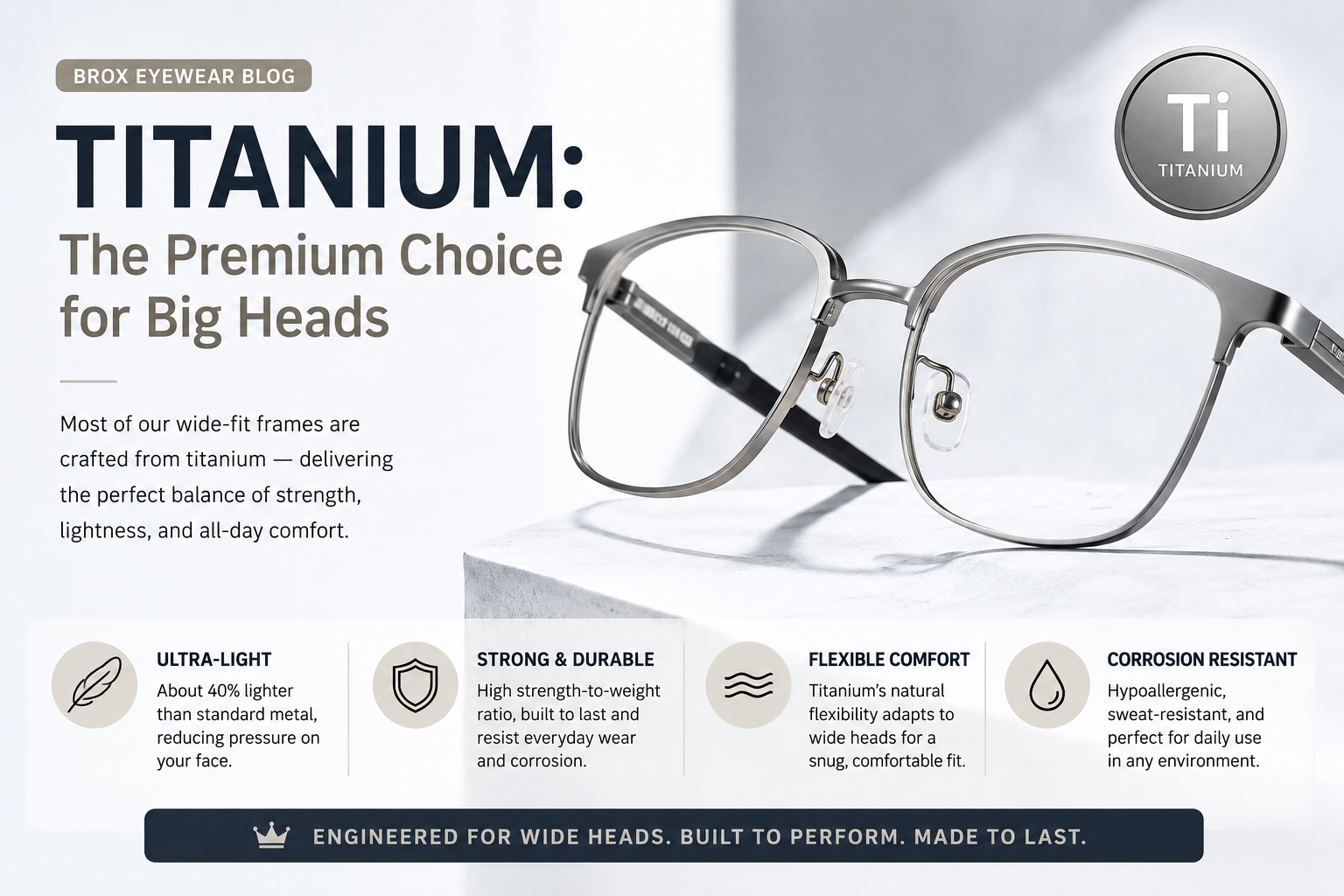
The same 150mm–160mm width principle isn't unique to sunglasses — if your regular prescription glasses also pinch or slide down, the cause is identical: a frame built for a 130mm–138mm standard head, not yours. Everyday glasses matter even more, since they're worn far longer per day than sunglasses. If that's a problem you're also dealing with, our titanium glasses for big head men guide covers lightweight, corrosion-resistant frames built specifically for daily wear at this width. Titanium Glasses for Big Head Men: 150mm–160mm Wide Frames
FAQ:Wide Frame Sunglasses for Wide Head Man
Q: Do polarized lenses add extra weight to big head frames?
Polarized lenses typically add 2–4 grams compared to standard tinted lenses — negligible on a TR90 frame under 25g total, but noticeable on heavier metal or acetate big-head frames exceeding 35g.
Q:How long does it take for a too-tight frame to cause a headache?User-reported data centers on the 20–40 minute mark for temple-induced headaches to begin, correlating with sustained pressure above roughly 150 grams-force at the temple contact point — well below the pressure threshold of a properly sized 150mm+ frame.
Q: How much does UV400 protection differ between narrow and wide frames?
UV400 blocks 100% of UVA/UVB up to 400nm regardless of frame width — protection level comes from the lens coating, not frame size. However, wider frames physically block more peripheral UV exposure around the eyes.
Q: What bridge width works best for wider faces?
Standard bridge width is 16–18mm; frames built for wider faces typically use 20–24mm to prevent the frame from sitting too close to the nose or creating uneven pressure across the bridge.
Q: Do sunglasses for big heads cost more than standard sizes?
Big-head frames (150mm+) typically run 10–20% higher than standard-width equivalents in the same material, mainly due to increased material use in TR90 or acetate construction and lower production volume compared to standard sizing.